

This week felt emotionally heavy both personally and for our country. I have no bandwidth to write anything thoughtful here, but I committed to myself that I would release a Substack every week this year, and I can’t let myself down on that promise in the second month, so here we are. If you are looking for actions to take: I called my senators using the 5 Calls app, which makes it really easy; I highly recommend. I also donated to the Immigrant Law Center of Minnesota.
If you’d like to submit a dating & relationship question or topic anonymously, for me to answer on this Substack, you can do that here. You can also DM me on the Substack app. Last week, I answered a reader submitted question about situationships.
I have hundreds of notes on my phone, going back to 2011, filled with ideas that interest me, quotes that resonate, details of events I’ve attended, lists of things I love, descriptions of partners and dates. So I read through my notes in the hope that it would spark something that I could muster the strength to write about and I found my summary of Esther Perel’s Sessions Live from last April. Esther gathers some of the most preeminent researchers, clinicians and therapists to discuss themes that we’re seeing globally in mental health. One of the most resonant conversations for me was Zachary Taylor and David Kessler discussing the relationship between grief and anxiety; which feels increasingly more relevant to the “unprecedented times” we’re all living through.
They define grief as “anytime we experience a change we didn’t want.” By that definition I would suspect that most of us are swimming in pools of unprocessed grief. This is what surprised me: often what people describe as anxiety is actually grief. And the two things have the exact opposite interventions.
Grief is a gravitational pull to the past; wishing things could return to how they were.
Anxiety is rooted in the future; worrying about the possible outcomes. It is a perceived lack of control over how things might unfold.
Grief is constricting, it narrows your world and collapses it inward, making it smaller and more insular.
Anxiety is overflow; a flooding of emotions, it fills your mind with looping, racing thoughts.
Grief is like being alone in a dark room; the intervention is expansion.
Anxiety is like a fire in the hallway; the intervention is containment.
Grief benefits from:
Light, air and witnesses, not solutions
Naming the loss out loud
Allowing memories, tears, anger, longing
Sharing the grief with others
An expanded identity (“I am more than someone who lost their husband.” “I am more than someone who is losing their country.”)
Anxiety benefits from:
Containment and boundaries, not exploration
Limiting rumination
Grounding in the body
Reducing input (from the news, social media)
Creating predictable routines
Kessler emphasizes that grief is metabolized through expression. It softens as it is shared. Anxiety needs boundaries to stop the rumination before it becomes falsely all encompassing; “everything is wrong.”
People usually do the exact opposite in both scenarios. They try to contain grief by “staying strong”, not talking about it and “pushing through”.
They try to expand anxiety by talking through it endlessly, scanning for certainty and trying to figure it out.
Where does that get us?
Grief becomes frozen inside us, prolonged and lonely, shrinking our lived reality
Anxiety gets louder and more all consuming, spreading to other areas of our lives
As the famous psychotherapist and grief expert, Julia Samuels reminds us; grief doesn’t begin with loss. It begins with love. It is not possible to grieve something or someone you didn’t love. You can have empathy or compassion for the person or the situation, but not grief. The depth of the grief is an indication of how deeply we love.
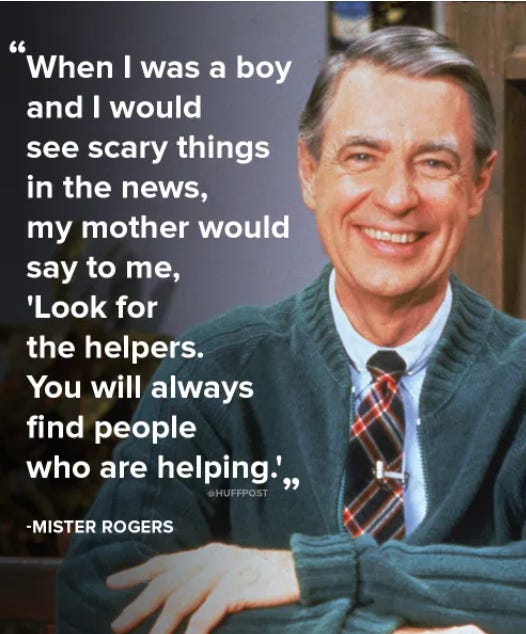
So with that, consider this an expansion of my grief: I love our imperfect country. I love that people are willing to fight for their values in sub zero temperatures. I love that there are people on Earth who are willing to put themselves in danger for others that they don’t even know. I love the helpers.
I’m anxious about what the future looks like, but I’ll contain that for now.
Content I Consumed this Week
I loved this book so much. It has a dark sense of humor and a happy ending. I’m blown away that it’s Madeline Cash’s debut novel; the writing is sophisticated beyond her years.
Allie Hoffman wrote a great piece about the dangers of manifestation culture for partnership and the inflexible “SuperDaters” with lists of 95+ qualities they want in a potential partner. I’m curious what people think of this.
This podcast in which Esther Perel discusses AI intimacy and our relationships with chatbots.
This piece about young people ordering illegal peptides from China in order “looksmaxx” completely blew me away.
In Case You Missed It
I answered a reader submitted question about setting a boundary with situationships.
I wrote predictions for dating and relationships in 2026
We are moving into the Year of the Fire Horse

Not exactly what you had intended and resonated so much with the experience of dating.