

This is part 1 of a multi-week exploration of co-habitation and community.
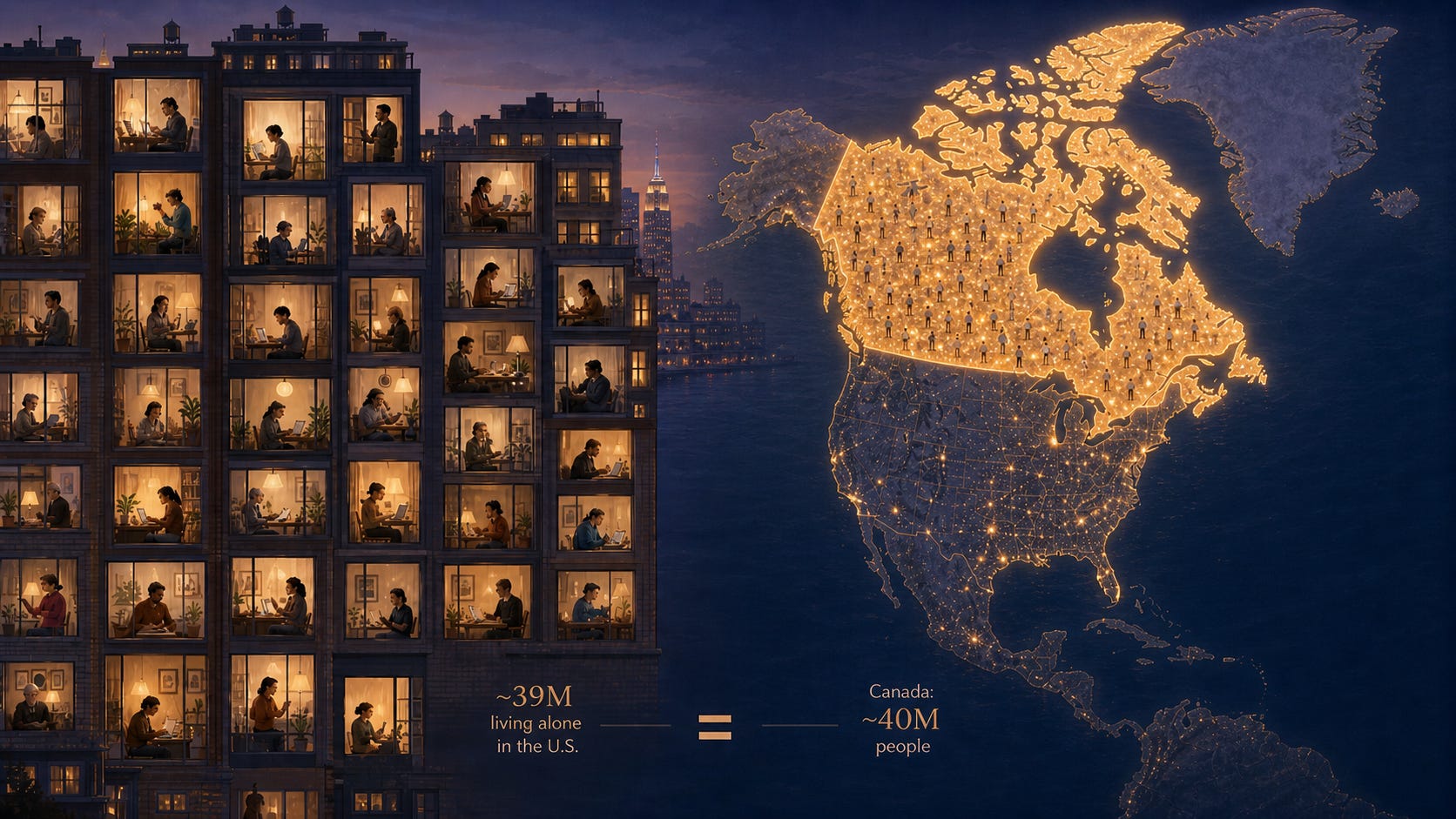
In 1960, approximately 7 million people lived alone (13% of the population)¹. Today almost 39 million people live alone (almost 30% of the population)².
To put it into context, we have almost as many people living alone in the United States as the entire population of Canada (approximately 40M).
Both the number of unmarried people and the number of people living alone have been on a similar upward trajectory:
In 1960, 36M adults were unmarried (33% of the population)³
Today that number is 117M (roughly 46% of the population)
Even if you adjust for population growth, if the rate of unmarried people had stayed the same as it was in 1960 (1 in 3 people), the total number today would be 86 million. The actual number of 117M means we have 31 million “extra” unmarried people.
What’s perhaps most notable about this growth in single adults is that:
“all of the growth in the unpartnered population since 1990 has come from a rise in the number who have never been married [as opposed to divorced and/or widowed.]⁴
The media has consistently framed declining marriage rates as a crisis, fueling a collapse of global fertility with profound economic consequences.
But what if the rate of singlehood isn’t a problem to be solved, but the next iteration of our cultural fabric?
To be clear; I don’t mean a life spent without romantic partnership but potentially a broader spectrum of life trajectories to aspire to, without a singular, defining partnership. A life that includes lovers, serial repeated monogamy and a variety of companions. Love and partnership potentially decoupled from cohabitation.
I am 39 and my mother is 81. She could not legally get a credit card in this country without the authorization of her husband or her father until she was 30 years old, with the passage of the Equal Credit Opportunity Act in 1974. Before 1974, women could be outright denied credit cards on the basis of sex or marital status, even if they were employed and high earning. My generation of millennial women is the first to grow up with the option for true financial independence and the least social pressure to get married. And what has happened?
Married couples are now the minority in this country.⁵
So it seems plausible that the number of single people we’re seeing is a closer to accurate look at how many people might have always opted out of marriage if it weren’t for financial restrictions and social pressure. Perhaps we have a more clear look at how many people would actually choose marriage based on love and romance?
Now that the veil has been lifted, what are the myriad of options for the future?
A caveat that this is not intended to be anti-marriage - but to open the aperture of possibilities for life and partnership. Marriage being one option among a growing set of life stories on offer.
The next few substacks will look at what this could look like for cohabitating and building community.
¹ U.S. Census Bureau, Families and Living Arrangements, 2021. https://www.census.gov/newsroom/press-releases/2021/families-and-living-arrangements.html
² U.S. Census Bureau, Children, Families, and Living Arrangements, 2023. https://www.census.gov/newsroom/press-releases/2023/children-families-living-arrangements.html
³ U.S. Census Bureau, Population Characteristics, 1961. https://www.census.gov/library/publications/1961/dec/pc-s1-12.html
⁴ Pew Research Center, “Rising Share of U.S. Adults Are Living Without a Spouse or Partner,” October 2021. https://www.pewresearch.org/social-trends/2021/10/05/rising-share-of-u-s-adults-are-living-without-a-spouse-or-partner/
⁵ U.S. Census Bureau, Families and Living Arrangements, 2025. https://www.census.gov/newsroom/press-releases/2025/families-and-living-arrangements.html
Content Consumption
Why marriage has hit a 140 year low.
Is cohabitation the feminist future?
Single women deserve a rebrand in 2026.
The return of the personal ad.
I wasn’t initially drawn to read Lena Dunham’s memoir, Famesick, and I’m so glad I did because I ended up loving it far more than I expected to. It reminded me how incredibly talented she was/is to get a blind pilot from HBO at the age of 24 and I suspect I’ll be one of many that begins a Girls rewatching renaissance.
It also sent me down a rabbit hole of listening to her on the Monica Lewinsky podcast and on The Daily. I also subscribed to her substack, Good Thing Going.
In Case You Missed It
Why Ibiza is the geographic representation of vitality, eroticism, life force energy.
A conversation with Dr. Eva Yacobi about why so many women feel emotionally flat
My personal healing journey with Jen Gnisci. We discuss how she works with women who are scared they won’t find partnership or have a child.
An analysis of the underlying cause of the manosphere.
A step by step exercise to finding your purpose, what energizes you, qualities to look for in a partner and qualities to cultivate in yourself for partnership
My wish for all of you on Valentine’s Day was more pleasure digestion and the discovery of your erotic blueprint.
If you have thoughts on this topic, I would love to hear them! You can submit anonymously here.
You can also reply to this email or DM me on the Substack app; I’d love to hear what’s on your mind as it relates to all things dating and relationships.
Excited for this series !
Love the start of this series. And looking forward to what’s next on cohabiting.