


A couple weeks ago, I answered a reader question about friendship. Part 1 of my answer addressed approaches to dealing with being in different life stages than your friends. If you want to read her full question - it’s included in the Part 1 post. Today’s post covers more tactical suggestions for creating a deeper richness in your friendships.
If you want to submit a question, I’d love to hear from you. You can submit anonymously here. Or DM on Substack:
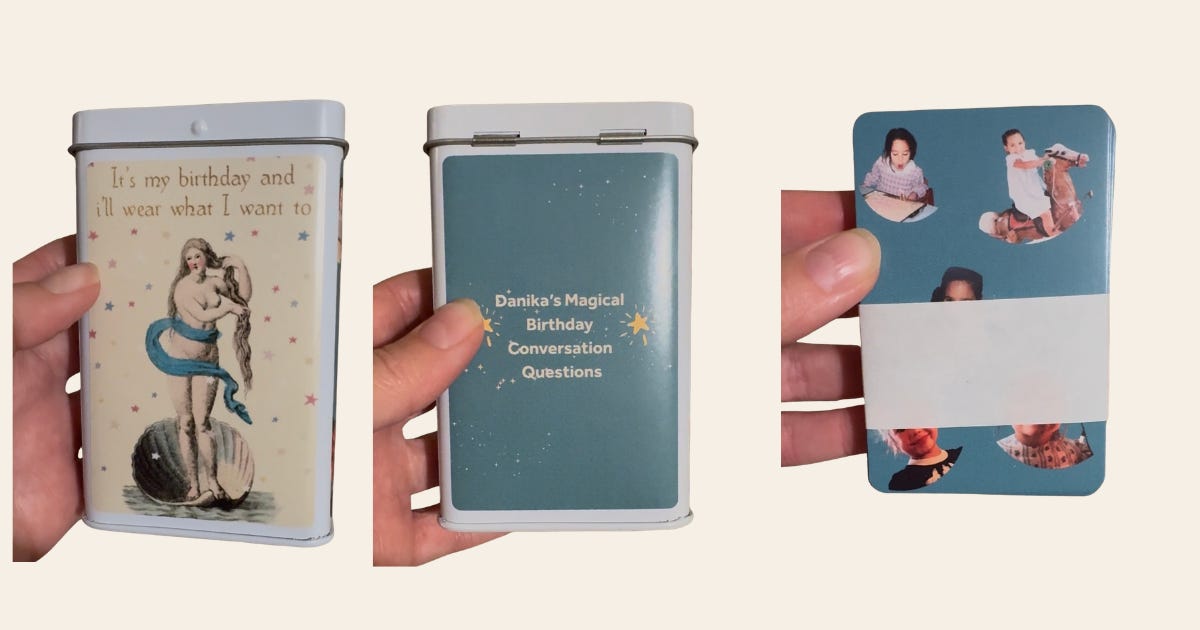
Question cards. For one of my friend’s birthdays I made her a deck of custom question cards because we love group table questions. i.e. someone pulls a card and the entire table has to go around and answer the same question. We now have the cards with us whenever we travel, and I’m always amazed by how many new things I learn about women I’ve known for decades. On the nights that we’ve done several rounds of the cards, I always feel really nourished by our conversations. The questions I used to make the custom cards are here.
Couples Therapy for Friendship Put the resources into your friendships that you would put into romantic relationships. A few of my friends all share the same healer, Jen Gnisci. Three of us did a girls trip to Holbox, Mexico a few years ago and on the trip, Jennifer joined virtually to lead us in a group session, with no other purpose than deepening our friendship. I’m always blown away by the power of group sharing circles; it’s a force multiplier of what happens in a 1 on 1 session. At the time, one of us was trying to get pregnant, one of us wanted partnership and one of us wanted clarity in their life purpose. I knew all of those desires going into the session; the actual facts weren’t new to me, but the depth of feeling that was shared in that session; the anxiety, the fear, the sadness, the what if I never get it? I had no idea the intensity of what they were holding. And I’m assuming they felt the same way for me. The experience made me feel immensely more close to them.
Institute a phone ban when you hang out; at least some of the time. I love asking for phone free dinners. I think we underestimate how much it fractures the quality of our time when one person reaches for their phone. So many of the best conversations are on the other side of that lull in table conversation and so often we never get there anymore because everyone uses that lull to check their phone.
Understand + value how they like to interact. One of my closest friends, for the most part, only texts for logistics. If I text “How are you?”, she’ll respond “good” and usually not even ask the question in return. She’s not chatty over text but in person, she’s deeply present with me. When we were younger it used to really irritate me that she wouldn’t check in over text. But now, I’ve stopped expecting her to be someone I text with and I’m grateful she’s so present with me when I see her.
Tell them how to love you. This Substack is really important to me; and when I started it I said some version of this to several friends; “This substack is really important to me. It would mean a lot to me if you read it, interacted with it and asked me about it.” I think it’s really important to let people know what’s important to you. And how you’d like them to show up for you.
Lovingly have conflict (never over text). I was upset about something that happened over my birthday and I sent this voice note to a friend asking her to have a conversation:
“Hey, I’m feeling disappointed about what happened at my birthday and I know you could feel my disappointment; so I’d love to be able to share what was going on for me and hear your perspective. I don’t want to leave anything unsaid that distorts the energy between us and leads to underlying passive aggression or resentment; so I’d love to have this conversation in the spirit of deepening our friendship. Can we find a time for a call when we’re both resourced and ready to talk about it?”
When you give the other person a heads up that you want to have a tough conversation, so that they’re not ambushed by the entire issue and you frame the conversation in wanting to deepen the relationship, it de-armors both people and sets you up to have a more open, empathetic conversation. The reality is that 9 times out of 10 if something has happened or there’s a rupture in the relationship; both people feel it and it’s such a relief to just address it head on. If this is a relationship that has longevity, leaving those things unsaid can be really corrosive. I’ve never had a conversation like this and not felt immensely closer to the other person afterwards. I can’t underscore this enough: I think it’s really important to not unleash everything you want to say in a text message; you have no idea what’s going on for them in that moment and how they’re going to receive it. There’s something about reading it in writing as opposed to hearing you speak the words that is much more likely to escalate the conflict, not resolve it.
“Everyone wants a village. No one wants to be a villager” And lastly, community is not just meeting for drinks. I love this definition of what community actually is:
A huge part of what creates intimacy is interactions that have more texture and potentially more friction: helping someone move, playing with their kids, cooking together, learning a hobby. Do the thing that feels inconvenient. I think we all need to get a little more uncomfortable and a little less individualistic.
In Case You Missed It
I wrote about leaving a relationship that I wanted to be a life story. And then my ex responded, which went viral. Highly recommend you stay for the comment section of that piece.
A conversation with the healer I mentioned above, Jen Gnisci.
I’d love to hear what you do to cultivate richness in your friendships:
Love this 🥰🥰🥰
Love this, Sara! Keeping the relational living room clean. So powerful🙌✨