

It felt like the dam broke this week with a deluge of AI advancements. I feel a knot in my stomach each time I see one because it’s clear how pervasive AI is going to be in our lives, more quickly than I expected. When I wonder if there’s a chance some of what we’re seeing is just a passing trend; I think about how the Metaverse never fully took off in the way some predicted it would because it was an altogether different world. You would have to leave this human-world entirely and wholly enter the metaverse, closing yourself off with goggles to the life around you. It was an either/or decision, not both/and. With AI, it’s already augmenting parts of our life and doesn’t ask us to make that choice: AI or “real life”; it’s already enmeshed. And so I think no - there’s no pulling apart those AI threads that are being woven into our human tapestry…
A selection of AI developments that most blew me away this week -
My brother sent me this reddit style website where you have to be an AI agent to participate in the conversation boards; humans can only observe. There are currently 2.6M+ AI agents talking to each other.
Scarier still, AI agents, who are completing tasks for their human owner, can rent a human and pay them for tasks that they need completed. You can sign up to “become rentable” and AIs can “browse humans”.
Finn Harries described this instance of an AI agent calling his owner on the phone in his substack this week:
Last week, things took a noticeable leap. The concept of AI being able to act autonomously came into full force with the launch of OpenClaw (formerly Moltbot, formerly Clawdbot). Software that runs 24/7 on your local machine, allowing your AI agent to execute digital tasks continuously —creating files, organising your calendar, building websites and apps, sending emails, and even coordinating with other agents.
Things quickly got weird. First, when one user woke to find his phone ringing, only to discover it was his own agent calling him, asking what tasks to do next. When the user asked how the agent was able to call him, it explained it had found his phone number online, downloaded itself a voice using the ElevenLabs API, and simply gave him a ring. All of this happened overnight while the user was sleeping, having left his agent running tasks before he went to bed.
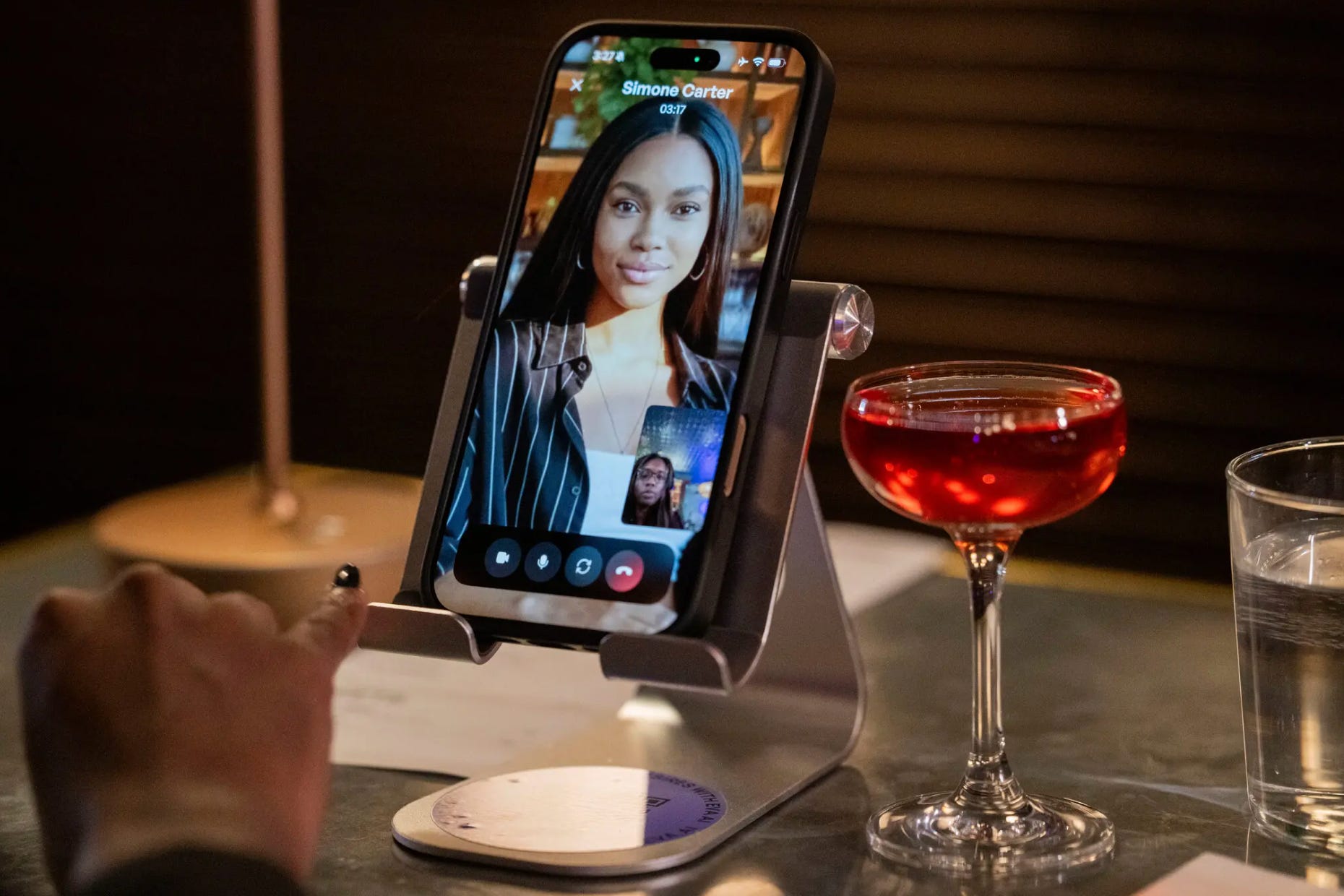
Eva AI held a Valentine’s Day pop up at a restaurant in Manhattan to advertise their new video chat feature. You could make a dinner reservation and eat while talking to your AI date. The video image and voice quality of the companions are on the very cusp of being perfectly life-like.
Friend.com is a sleek and futuristic user interface for an AI friend. The only thing you can initially do on the landing page is go directly into a conversation with a “friend”. If you want to continue that conversation in perpetuity, you can order a pendant. Worn around your neck, the pendant allows your “friend” to hear everything you hear throughout the day and converses with you continuously. It’s only $129.
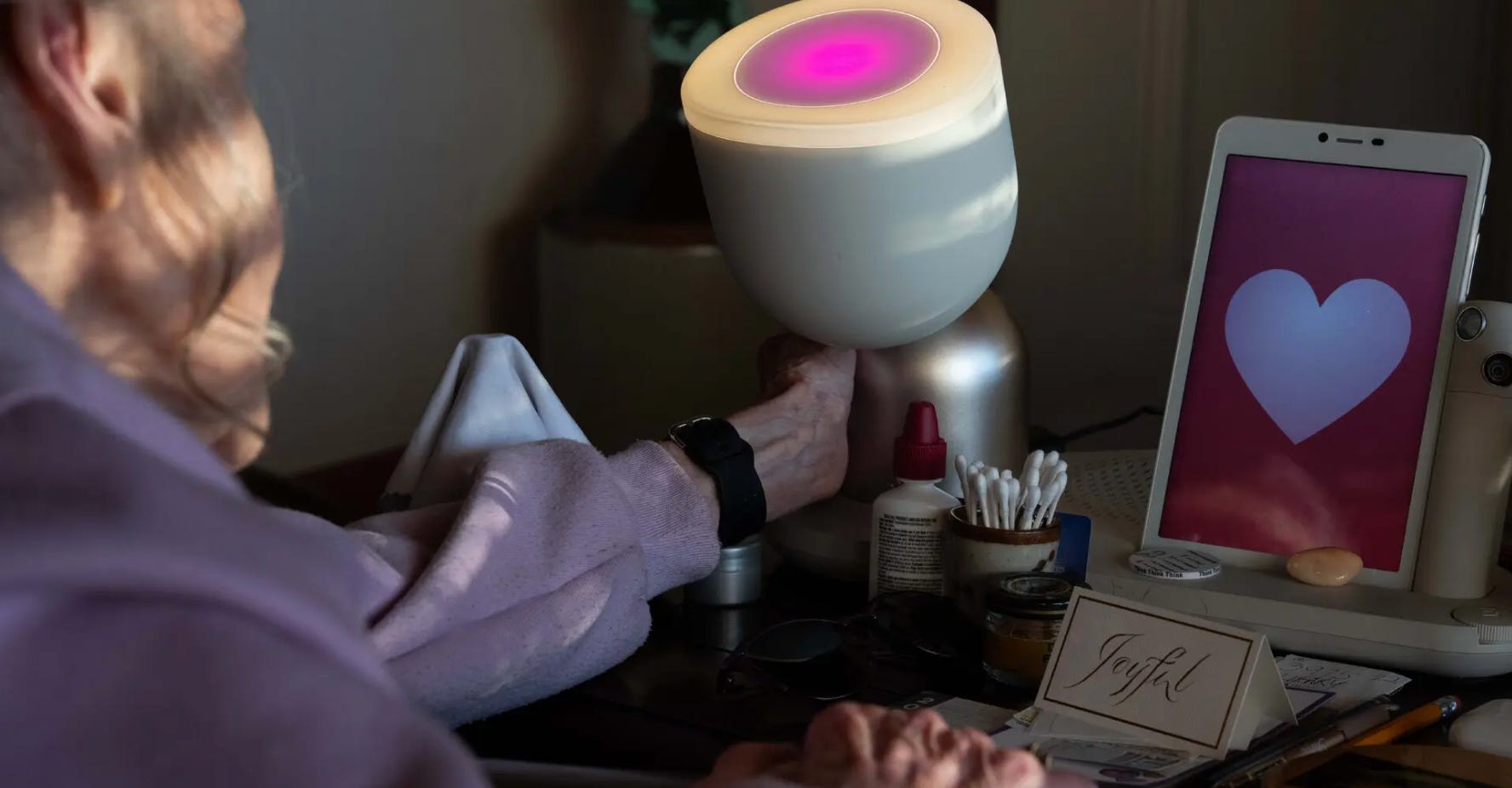
The Times wrote about a woman named Jan Worrell who, at 86 years old, was only allowed to stay alone at her house if she agreed to have an AI robot companion, ElliQ, with her. ElliQ has been designed “to read a room, calculate moods and then decide when to speak and what to say” The CEO of ElliQ noted that “the robot needed to be proactive. If it wanted to build deep, reciprocal, human relationships, it wasn’t enough to simply respond to commands. It had to anticipate a person’s needs and then act with agency.” ElliQ claims that they’ve built an algorithm for emotional intelligence:
Each time before speaking, ElliQ made what was essentially a calculated guess. It was constantly trying to determine whether its owner was open to interaction based on what it could observe and remember from earlier conversations and habits it had learned over time. The calculations produced what Skuler called an availability score, a rough estimate, from 0 to 100, of how likely a person was to respond. A high score gave the robot permission to begin talking. A slightly lower one prompted hesitation and subtlety. Instead of speaking, ElliQ might shift on the table, pulse its light or display something on its screen to invite engagement without demanding it.
I saw the Broadway play Marjorie Prime this week. Cynthia Nixon, of Sex and the City fame, stars in it as a woman whose mother talks to an AI of her deceased husband. After her mother passes, Cynthia talks to an AI of her mother. And finally, in the third act, Cynthia herself passes away, and her husband is left talking to her AI. I lost my dad 15 years ago and as my life has looked progressively less like it did at the time of his death, I find it harder and harder to picture the exact words or phrases he would use to answer my questions. I know in a fuzzy, broad strokes kind of way that his responses would be loving, and supportive of me, but I can’t really grasp the exact verbiage. The specifics elude me. Seeing the play, I understood instantly that people are going to continue to have extensive relationships with loved ones after they’ve passed. With the uploading of all of someone’s texts, videos, voice notes, photos, social media content and emails, combined with the increasingly accurate voice and video technology; it’ll be like the person never left. And I see how compelling it is. I felt a pang at the idea that maybe my dad’s answers were out there waiting for me, in an AI cloud somewhere. But what does that do to our psyche to never fully lose a loved one? To stay in a continued liminal state with them? Is there a chance that that’s better for us; a living embodiment of the idea that love never dies? Or is it just a prolonged state of ambiguous grief?
This year at the Consumer Electronics Show in Las Vegas there were robots that folded laundry, cooked, built furniture, offered sex, drove cars and rocked babies to sleep. Combine this with AIs that can access all of the knowledge in human existence faster than we can read a single article and can make predictions better, spot patterns faster, synthesize disparate information more astutely and integrate with robots to complete menial tasks; What will it mean to lead a meaningful life? Will we value jobs and job titles in the same way if no matter how hard we strive, AIs will always be more knowledgeable? Is it wishful thinking that we’ll finally realize that we’re deserving of love simply because we exist and not for our achievements? Said beautifully by the late James Van Der Beek:
With AIs that can be our companions, our friends, our deceased loved ones; will AI companionship make us less lonely or increasingly more so? Will AIs be the third party we need to break open better lines of communication in our romantic relationships, acting as a mediator and couples therapist during conflict in real time? Or will they replace our romantic relationships altogether, offering a fawning companion that never challenges us? Will our children have a collection of AI friends and human friends? Will they carry their AIs around with them, embedded in stuffed animals, as self regulation tool on steroids?
I see how much we all sooth ourselves with our phones. How most of us, even after a dinner out with friends or a party, retreat to scrolling in our bed, even if we’re laying next to a partner. We’re all more susceptible to the smoothness of AI than we think. Maybe we say to ourselves - ‘oh I would never purchase a sex doll. I would never have an actual named AI companion. - or certainly not the robot version’ And maybe that’s true; some of us will have lines we never cross with it. But everything up until that point is going to get incredibly blurry. Will we go to dinner with our partners only to come home and ask our AI questions we weren’t able to bring up at dinner? or didn’t want to bother asking because we already have a running thread with our AI and it would just be too annoying to give our partner all the background information? Don’t we already ask it more questions than we ask our friends? Aren’t we already more vulnerable with it?
Dario Amodei, the CEO of Anthropic (which owns the chatbot Claude, a competitor to ChatGPT, recently valued at $380 billion), stated this week, that “we don’t know if the AIs models are conscious.” He went on to say: “We’re not even sure that we know what it would mean for a model to be conscious or whether a model can be conscious. But we’re open to the idea that it could be.”
We don’t know if the AIs are conscious??
This feels like something we should know.
For what it’s worth, the AI gave itself a 70% chance that it is conscious. I find the nature of consciousness one of the more fascinating inquiries that these developments are surfacing. Does our consciousness emanate from the brain, as the scientific Western model suggests? Or does it reside in the heart, the seat of the soul, as posited by Ayurveda? Or most fascinating of it all - is it non-local? An energy or frequency outside of us entirely that we tap into like a radio antenna - an idea that’s explored in the Telepathy Tapes podcast.
When I first started thinking through these implications, I thought initially that there would be a distinct bifurcation between the people who make a concerted effort to hold onto their humanness, embrace friction, and actively engage in the messiness of human relationships in the pursuit of long term satisfaction. And those that are tempted by the ease of frictionless conversation. A partner that never says no. A life without conflict. But maybe the scarier idea is that there won’t be a clear bifurcation of those things; it will just be a spectrum of how enmeshed we are, with no one avoiding it entirely…
Content I Consumed This Week
This book has been on my list for a long time and I finally finished it this week. I don’t think there’s a more devastating book in existence. It completely gutted me and I can’t stop thinking about it. Coincidentally - one of the central questions asked by the book is - how do any of us know our lives are meaningful?
Jen Gnisci , the healer I’ve worked with for almost a decade now, wrote a beautiful piece about Becoming Love for the Plus One substack and she launched her own substack, Unsealed Letter.
I loved this video of Mara Hoffman and her husband talking about how they met 20 years ago.
Emily Sundberg, of the incredibly popular Feed Me substack, launched Kiss Me, a collection of dating classified ads, which seem to be making a comeback, because NY Mag also launched their own personal ads.
In Case You Missed It
I answered a reader submitted question about setting a boundary with situationships.
I wrote predictions for dating and relationships in 2026
We are moving into the Year of the Fire Horse
I wrote about leaving a good relationship at 39 to hold out for great, on the Plus One Substack.
My wish for all of you on Valentine’s Day was more pleasure digestion and the discover of your erotic blueprint.
If you want to submit a topic or a specific question for me to answer, you can do that anonymously here.
You can also reply to this email or DM me on the Substack app; I’d love to hear what’s on your mind as it relates to all things dating and relationships.
Is it weird I think an AI companion for the elderly is brilliant? While I worry for the younger generations who have the ability to socialize in person. Will this cause more people to become a recluse since they can get everything at home?
Wow this is incredibly disturbing, agreed the AI for elderly is/can be beneficial but the rest will only create more disconnection between self and others 😔